
Unliquidated Equity
The boardroom had floor-to-ceiling windows that overlooked the city. The quarterly numbers were on the wall. Red dominated the slide.
“Watch time per user is down eleven percent,” the CFO said. “At some point we need to address what’s happening.”
The CEO reached for her water glass. Took a slow sip. Set it down.
“I’d like to show you something.”
A single number appeared on the wall. One hundred eighty.
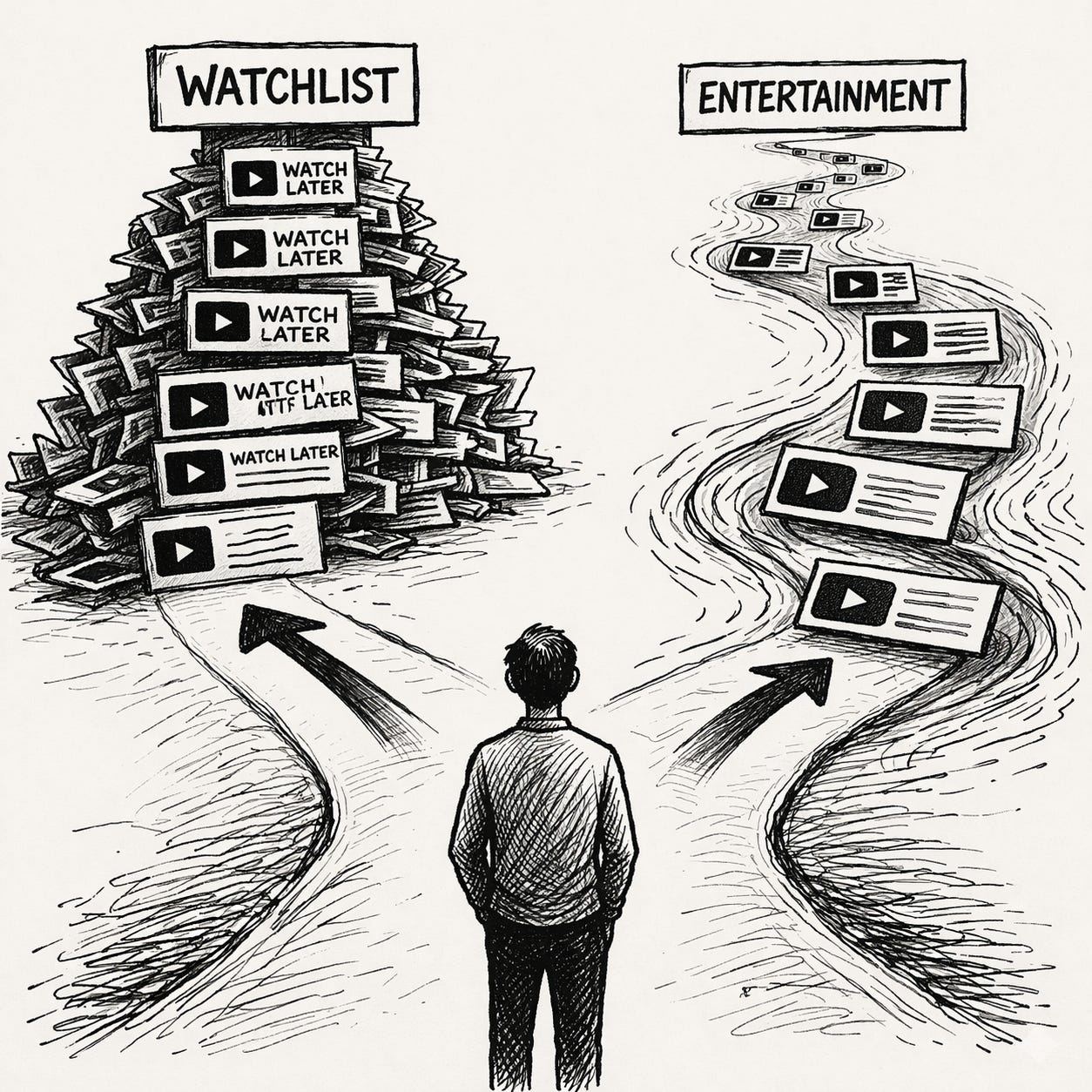
“That is the average number of videos in a user’s watchlist. Last year it was one hundred twenty. The year before, seventy three. While watch time declined, this number has grown every quarter for five years.”
The CFO frowned. “They’re saving more but watching less. How does that help us?”
“Educational content has a thirty-two percent save rate. The completion rate on those same videos is four percent. Entertainment content has a lower save rate but completion rates over sixty percent. That is where ad revenue comes from.”
“So we’re using educational content as a loss leader.”
“We are meeting users where they are,” the CEO said. “When users encounter something that makes them feel they should watch it, that creates pressure. A kind of discomfort. The save function resolves that. The user feels they have handled it. And then they continue on.”
The CFO looked at her. “The need to feel like they’re improving themselves without actually doing it.”
The room went quiet.
“The need to resolve the discomfort of walking away from something that feels important,” the CEO replied. “That is a real need. We did not create it. We just built something that addresses it.”
She believed this. That was not performance. She had watched the data for years, watched real people use the platform, and what she saw was not manipulation. It was accommodation. People were tired. People had more things demanding their attention than they had attention to give. The save button let them breathe.
The Mechanism
“They save a video,” the CFO said. “They feel better about not watching it. Then what?”
“We tracked two hundred thousand users over six months. Eighty-three percent of users who saved a video either watched something else within six minutes or stayed browsing. The save resolved the decision. It freed them to keep going.”
“And users with very large watchlists?”
“Our lowest churn rate. Under two percent annually. The watchlist represents something to them. An intention. People do not leave a place where they have unfinished business.”
A board member leaned back slowly. He had teenage children who used the platform. He did not say this.
The Edge
“This demographic breakdown. Users eighteen to twenty four. Churn rate nearly double the average. That does not fit the pattern.”
“We are seeing that. Last two quarters.”
“What is causing it?”
“Younger users treat the watchlist differently. More fluid. They save and move on without building the same attachment to the list. The retention behavior we see in older cohorts does not replicate.”
“So the mechanism does not hold for them.”
“It holds differently.” The CEO paused. “We are still learning what that means.”
The CFO set down her tablet. She was not trying to win an argument. She was trying to understand something that worried her. “We are building a strategy around a behavior we do not fully understand, that does not hold consistently, and where we cannot predict what happens when users break the pattern.”
“Every strategy has uncertainty.” The CEO said this without defensiveness. It was simply true. There was no version of this job that came without it. “What matters is whether the core holds for enough people long enough to build something durable.”
“Until it doesn’t.”
Neither of them said anything for a moment.
The Risk
“What is our exposure,” the CFO said, “if someone frames this publicly. A platform that keeps users feeling good about not doing the thing they came to do. What happens then?”
“That is not what we are doing.”
“I know that. But it is how it could be written. Users start questioning the list. Start deleting. The behavior we have optimized for loses its hold. Then what?”
The CEO looked at the graphs on the wall. She had looked at versions of these graphs for years.
“We would adapt.”
“To what? If the foundation shifts, what are we building on?”
“We have a team watching for early signals. Real time. If the pattern starts changing we will see it.”
“But you do not have a response ready.”
“No. Because the pattern is still strong.”
The CFO nodded. Not satisfied. Not critical. Just absorbing. “I need the risk scenario. What it looks like if this becomes a moment. If someone writes the piece that makes people look at their watchlist differently.”
“End of week.”
The Aftermath
The meeting moved to other topics. Budget. Roadmap. Hiring.
The board approved the quarterly strategy. These were careful people. Experienced people who had spent careers learning to read numbers and terrain and the distance between where you are and where things might go wrong.
The CEO stayed after they filed out.
She reached for her water glass one more time.
It was empty.
Somewhere in the data centers, servers registered the encounter. A user paused on a documentary they just started. A half-second hover. The small private moment of someone trying to be who they mean to be. Then pressed save.
A number updated. Not the average. Just one person’s count, unremarkable inside millions of others.
One hundred ninety four.