
The Calf Gets It First
Exploring the prerequisites for empathy
People ask me why I don’t eat cow. Not always rudely. Usually with genuine curiosity, the way you’d ask about something you don’t understand. Is it religion, they ask. Do you worship cows.
I find that question interesting. Not offensive. Just interesting. Because nobody asks a person who grew up with a dog why they don’t eat dog meat. That answer is obvious. You know that dog. That dog is one of yours. The question answers itself.
The cow question assumes the answer lives inside a rule. A god, a book, a prohibition handed down from somewhere above. But I grew up spending summers at my grandparents’ village. They had a cow. Every morning, my grandmother would go out and milk her, but only after the calf had eaten. Some mornings there was enough milk for everyone. Some mornings there wasn’t, and we had our tea plain, and nobody remarked on it. That was just how it worked. The calf was young. Young things eat first. It was the same logic as the dinner table, where if food was short, the children ate before the adults. Not a rule anyone recited. Just an understanding that lived in the house.
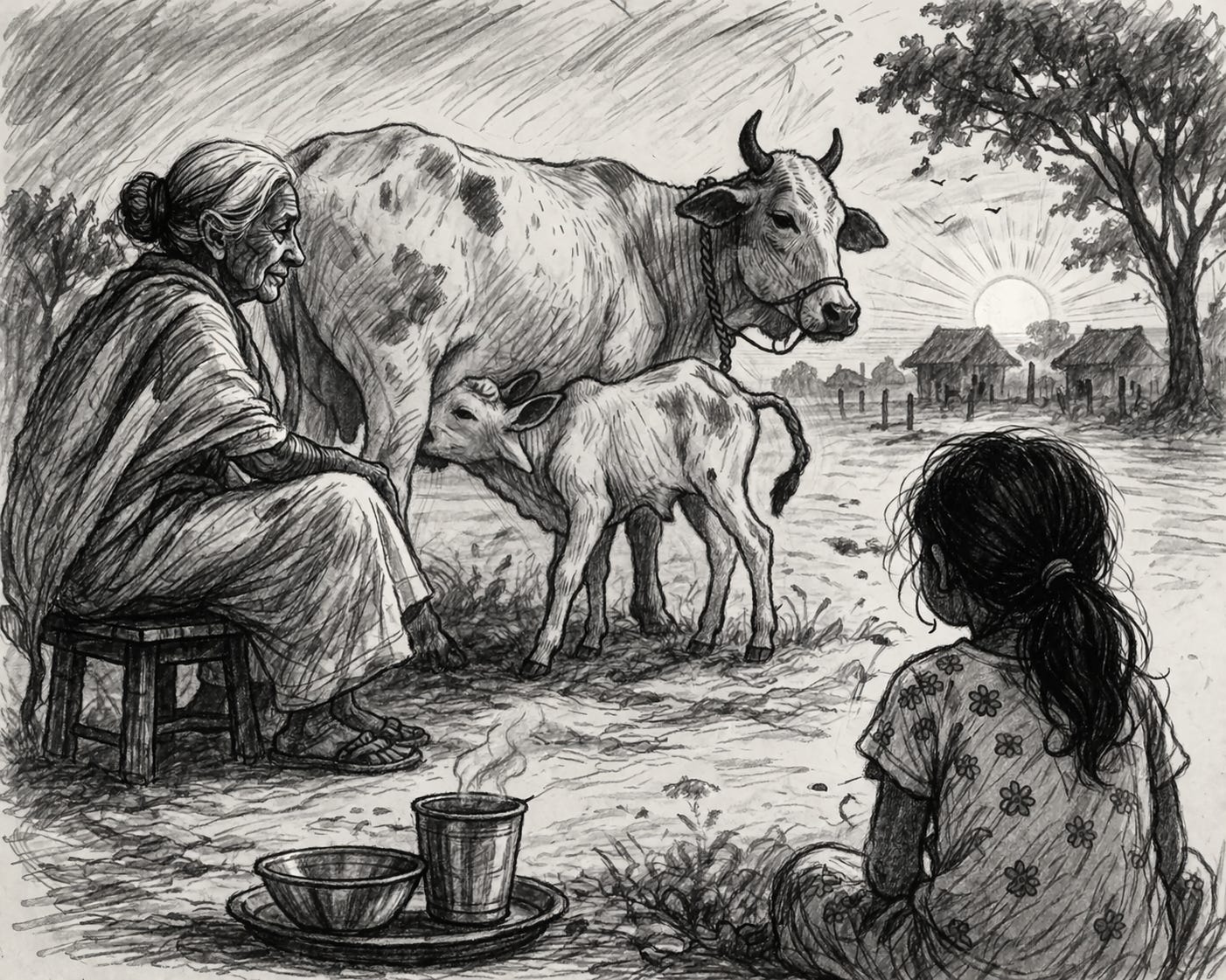
I played with that calf. I watched it circle its mother in the early morning, the light still flat and grey, my grandmother sitting on her low stool with the quiet patience of someone who has done the same thing for thirty years. And at some point, without anyone telling me, that animal moved out of one category and into another. It was not livestock. It was not food. It was just one of us. Small, young, with a mother, needing its share before the rest of us got ours.
When someone asks me why I don’t eat cow, what they are really asking, without knowing it, is this. How do you decide what gets protection and what doesn’t. And the answer, the honest one, is not god. Not law. Not a rule handed down from a book. It is relationship. It is having played with the calf. It is having waited while it ate first.
That waiting was not nothing. Those mornings with plain tea, that patience my grandmother carried to her low stool, the grey light before the village woke up. All of it was the relationship being built one morning at a time. The friction was not a problem to be solved. The friction was the point. You cannot connect with something that never asks anything of you.
I think about that a lot now. Not about cows specifically. About friction.
We have become very good at removing it. Every service, every platform, every interaction is smoother and faster and more shaped to exactly what you want. Your feed knows what you like before you do. Your recommendations arrive before you ask. Nothing needs you to wait. Nothing asks you to adjust. The whole architecture of how we spend our attention has been carefully, methodically built to remove every rough edge.
And we call this progress. Which it might be. But here is what I keep circling back to.
The friction was how people became real to each other.
The neighbor you had to negotiate with over the shared wall. The colleague you had to find common ground with even when you didn’t want to. The friendship that asked something of you before it gave something back. The relationship that had bad days and slow days and days where the milk wasn’t enough and you just accepted that and moved on. All of that inconvenience was doing something underneath. It was building the understanding that the other one has a claim here too. That their needs existed even when those needs were inconvenient for you.
A machine doesn’t have a bad day. It doesn’t need the milk first. It is perfectly available, perfectly patient, perfectly calibrated to you. And so you never build the thing my grandmother had on that low stool. You never develop the reflex that says, wait, this other thing has a claim on the resource.
We are not becoming cruel. That is too simple and probably wrong. We are becoming people who are very good at being served and slowly less practiced at the negotiation that makes someone else’s existence feel non-negotiable to you.
Resources will get tight. They always do. Energy, space, water, attention, whatever the constraint turns out to be. And when they do, we will look around and make decisions about who belongs and who doesn’t, who is us and who is not, who gets the milk and who gets the plain tea.
And here is where the categories start to do something strange.
The person who grew up with a Labrador will not eat a Labrador. But wolves are not exactly dogs. A wolf is wild, different, not the one you knew. That distinction is small but it is enough. And once you accept that distinction, the next one is easier. That breed is not quite the same as the one from the village. That group is not quite like the people from our street. That population uses more than their share of the resource. Each line drawn just a little further than the last. Each one reasonable. Each one arrived at without force, without malice, with perfectly calm logic.
My grandmother didn’t have a philosophy about the calf. She had a relationship with it. And that relationship made certain things simply unthinkable. Not wrong in an argued, reasoned way. Just unthinkable. The way eating your dog is unthinkable. You don’t need a rule for it. The relationship does the work the rule would otherwise do.
A generation growing up inside an architecture of frictionless service, of perfect personalization, of connection without negotiation, is a generation that is not building those relationships. Not because they are worse people. Because the mornings that built them are disappearing. The plain tea. The patient woman on the low stool. The calf that didn’t know it was teaching anyone anything.
And when the resource gets tight enough, and the squinting starts, and someone draws a line just a little further than you expected, it will not feel like a rupture. It will feel like a reasonable distinction.
It always does.