
The Borrowed Conscience
Can reason replace ritual
Every morning, before the village found its noise, my grandmother carried her low stool to the cow. She would wait. The calf ate first. Some mornings there was enough left for everyone. Some mornings there wasn’t, and we had plain tea, and nobody remarked on it. Young things eat first. Not a rule anyone recited. Just an understanding that had settled into the house over years until it became invisible, the way the walls became invisible.
I never learned that. I absorbed it. Those grey mornings, the calf circling its mother, my grandmother’s patience, the specific quiet of someone who has done the same thing for thirty years and stopped experiencing it as a choice. At some point, without announcement, that animal moved into a different category inside me. Not food. Just one of us.
My daughter knows not to harm the cow. She knows because I told her. She understands the reasoning. She agrees with it. But she has never waited for the calf. She has never had plain tea because something else needed the milk first. She holds the principle the way you hold something you have examined and found sound. But it is not the same thing.
The knowing traveled one generation and changed its address. It moved from the body into the mind. And here is what nobody tells you about that migration. The body does not negotiate. The mind does.
There is a version of this playing out at a scale that has nothing to do with cows.
The person who looks at the moral framework handed down through centuries of religion and says, I can reason my way to the same conclusions, I do not need a god figure to show me. That person is often right. The conclusions land in the right place. The life built from them can be careful and considered and genuinely good.
But they are spending from an account they did not open.
Somewhere upstream, religions did the slow unglamorous work of building a floor. Not a set of conclusions. A floor. The distinction matters. Conclusions can be revisited. A floor is what you stand on while you argue about everything else. It holds not because it is proven but because everyone agreed, before the argument started, that this part is not up for discussion.
Of course, in practice, religious traditions were never seamless. They had their own schisms, reformations, and internal negotiations. But, the genius of placing that floor inside a divine framework is something we have not adequately replaced. When the first principle comes from God, it sits outside human jurisdiction. You cannot out-reason a commandment. Not because there is someone watching from above, but because the structure of the claim puts it beyond the reach of any argument a human can make. The conversation simply does not open. Everyone in the room accepted that in advance, before the grievance arrived, before anyone knew whose interest was at stake. That prior acceptance is everything. The closing is not an act of power. It is just the rule.
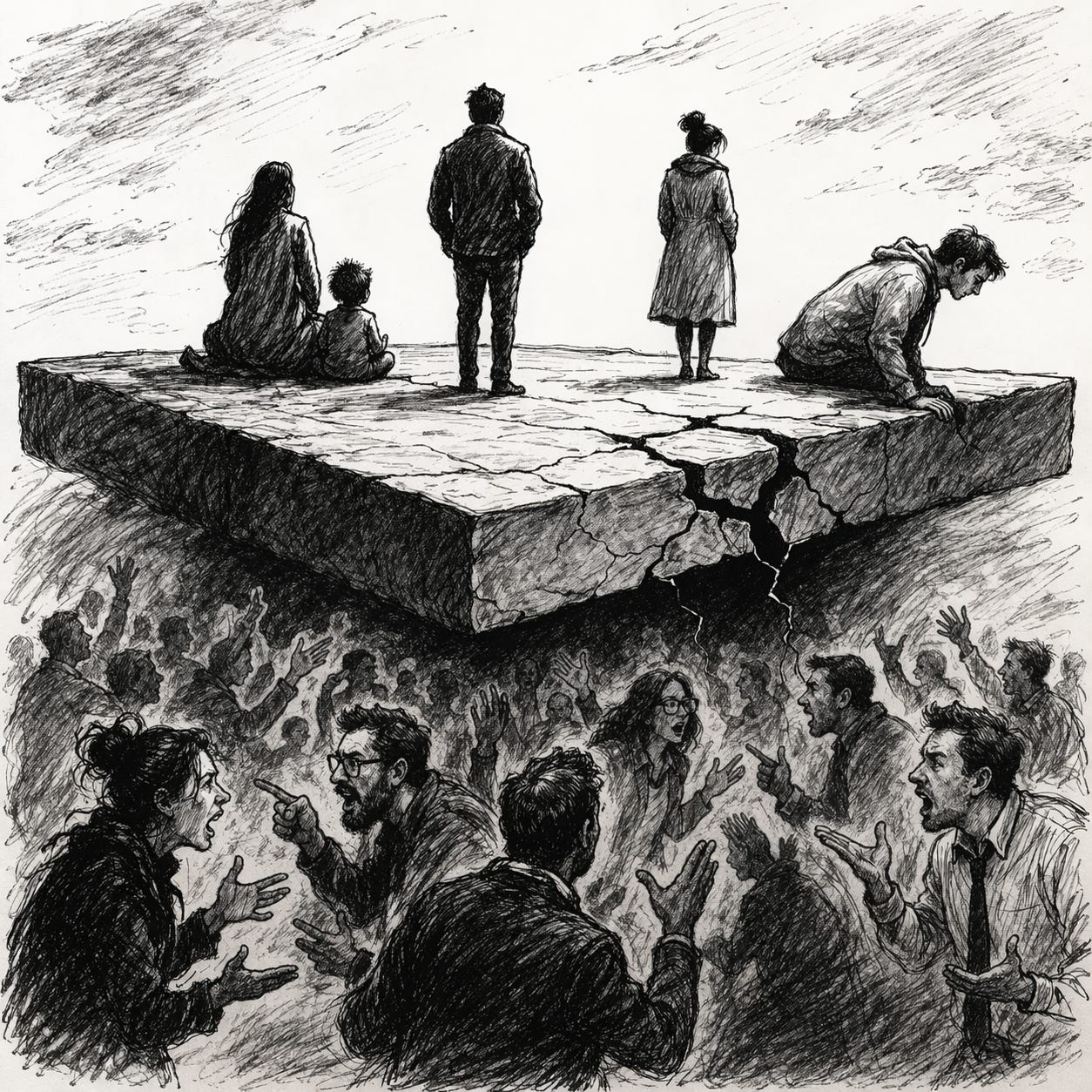
The secular replacement for this is consensus. Democratic values. Human rights frameworks. Real, and carefully built, and worth defending. But they carry the seed of their own negotiation inside them. Because they were arrived at by humans, they can be revisited by humans. The door that reason opened, reason can walk back through.
And so we litigate. Everything. Always. At a cost that does not show up on any balance sheet but is being paid somewhere. Not because we are worse people. Because we removed the floor and replaced it with a very sophisticated ongoing meeting. The meeting is exhausting. Exhausted people make worse decisions than people who simply know certain things are not on the agenda.
Now push this forward two or three generations.
The person who grew up with a dog will not eat a dog. That is not a position they hold. It is something closer to bedrock. You cannot argue them into it because there is no argument happening. The category is simply fixed. But take someone who never had a dog, who never had those mornings, who received the principle as an idea rather than a relationship. They can engage with the question. They can weigh it. And in a moment of scarcity, when something has to give, that willingness to engage is the crack.
This is where the reasonable distinctions start to multiply. A line drawn here, another there, each one just far enough from one’s own experience. The person with the dog cannot explain themselves in a way that survives a real debate. They can say it is wrong. The other person can ask, by whose measure. They can say it is cruel. The other person can say, cruelty is a feeling not a principle, and my child’s hunger is also a feeling. Every justification they reach for will sound, to someone without the lived experience, like sentiment asking to be treated as ethics.
The negotiation is not between two moral positions. It is between a moral position and a lived reality. And lived realities cannot be transferred through argument. Only through experience. Which the other person does not have and cannot be given in the middle of a negotiation.
This is the moment the borrowed framework meets its first real test. And the borrower is not unprepared because they are a worse person. They are unprepared because they never had the plain tea morning that made the floor feel like the ground itself.
I sometimes try to imagine what my daughter’s hard morning will look like. She will not have a grandmother on a stool, a calf to wait for. What she will have is a sentence I spoke, a principle I explained. She will have to choose whether to hold it, and she will have to do so alone, in real time, without the ritual that once made those choices invisible. That is what abstraction costs.
We have tried to build a secular equivalent. Something with the finality of a divine commandment but derived from reason alone. The closest we have come is MAD. Mutually assured destruction. The stakes are absolute. The consequence is total. No one wins. It should function exactly like a first principle. Inviolable. Not up for discussion.
And yet. War is different. Self defense is different. This particular situation has nuance. The crack appeared almost immediately. Because the crack was always there. Someone has to decide when the exception applies. And that someone is human. Humans can be pressured and reasoned with and threatened and sometimes they are simply wrong.
The divine version had no crack. Not because God was watching. But because the person sitting at the negotiating table, or deciding whether the neighbor’s dog counted as food, had already internalized the floor before they ever arrived at the moment of decision. The rule was not experienced as a rule. It was experienced as reality. The way my grandmother did not experience waiting for the calf as patience or virtue or restraint. She just waited. That was how the morning worked.
Self policing at civilizational scale requires every individual to carry the full weight of the framework internally. Without external verification. Without the ritual that rebuilt the reflex each week. Without the community that made the alternative feel unthinkable rather than merely wrong. Without the plain tea morning that cost something real and built something durable in the paying of it.
That is not a system. That is a prayer.
We are, most of us, still behaving well. The framework is holding. The grace period is long and we have been lucky inside it. But the grace period is not the same as the foundation. And the generation growing up now, the one that has never waited for the calf, that holds the principles as ideas rather than as mornings, that will have to self police under conditions we cannot predict, on a floor that has never been tested under load.
My grandmother did not need to believe in the idea on a hard morning. She just knew the calf.
What do our kids hold onto on the hard morning?