
Desperate Measures
On the invisible cost of visible progress
The Discovery
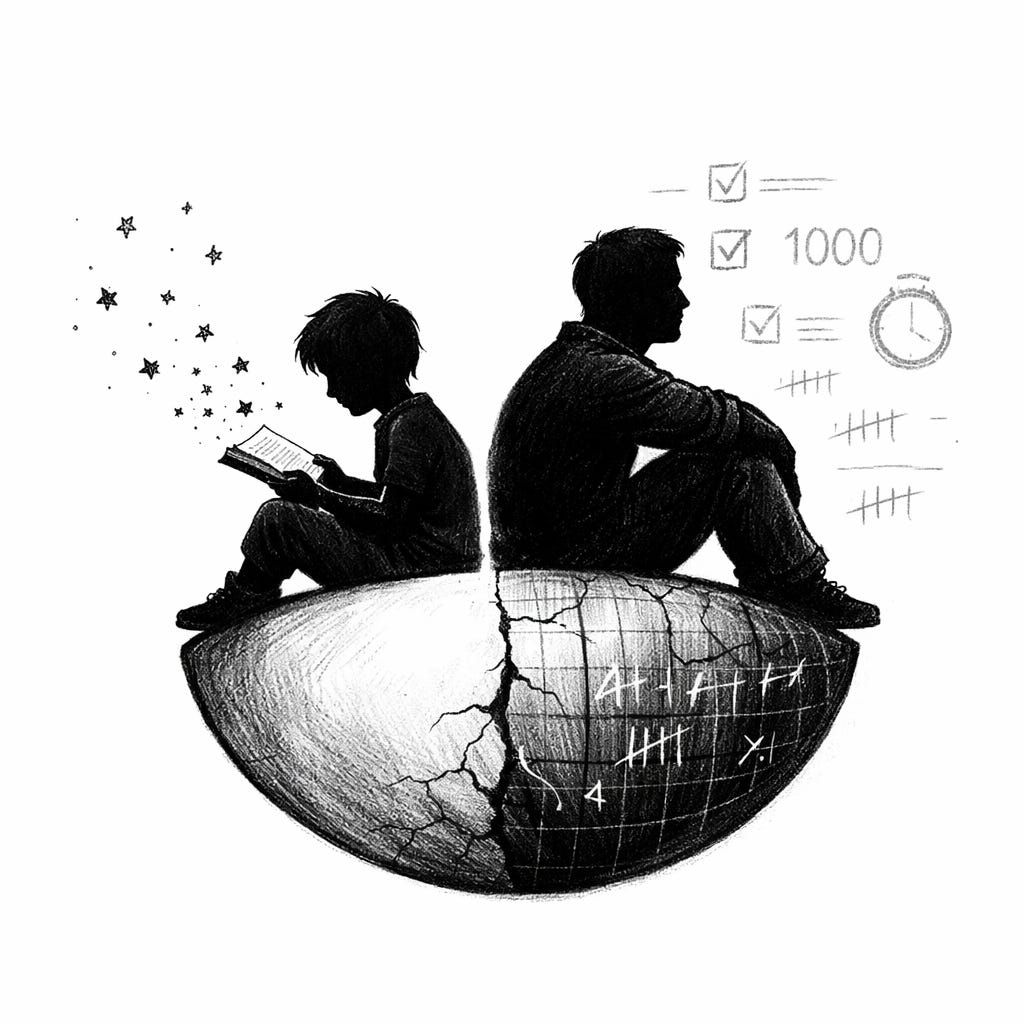
He was seven when he found it at the library. A thin book with a watercolor boy standing on a tiny planet, stars scattered around him like distant questions. The Little Prince. He checked it out because the cover looked lonely in a way he understood.
That first night, he read until his mother called him for dinner. He came to the table distant, still inside the story. After dinner, he went back. He read about the rose, prickly and vain and somehow precious. He read about the fox who wanted to be tamed. He stopped at a line that hit him like a sudden drop on a rollercoaster.
“What is essential is invisible to the eye.”
He sat with it. The words felt true in a way he couldn’t explain.
He read the book again the next week. And again the week after. Each time, different parts caught him. The businessman counting stars he thought he owned. The lamplighter who kept his promise even when it exhausted him. The snake who promised an answer that sounded like ending.
Sometimes he would read three chapters in a sitting. Sometimes he would read a single page and stop, thinking about it for days. He brought it to the park and read the same passage about the fox four times, looking up between readings to watch the trees move. Each time he returned to it, he found something new, not in the words, but in himself. The book wasn’t teaching him. It was revealing him.
His mother asked once what the book was about. He tried to explain but couldn’t find the words. “It’s about a prince. From space. And a rose.” It sounded silly when he said it. But it wasn’t silly when he read it. When he read it, he disappeared into a place where nothing else mattered. Time dissolved. The world outside fell away. He would surface hours later, blinking, returning from somewhere he couldn’t name but wanted to protect.
The book was due back at the library. He renewed it. Then renewed it again.
On the third renewal, his mother said something encouraging.
“You’ve read that so many times. You must have it memorized by now.” She smiled. “You’re so smart. Let’s find a more challenging book.”
He smiled back, uncertain. That night, he opened it one last time. He came to the line about the fox. “It is the time you have wasted for your rose that makes your rose so important.” He didn’t understand it fully, but he understood it mattered. He fell asleep with the book on his chest.
The Shift
The next week, she brought home a different book. Thicker. A fantasy series other kids at school were reading. He started it. It was fine. He finished it in a few days and moved to the next one.
His teacher introduced a new program that fall. Accelerated Reader. Every book had a point value. You read the book, took a quiz, earned points. There was a chart on the wall showing everyone’s progress. Gold stars for the top readers.
His mother loved it. “This will really help you grow as a reader,” she said. She checked his points every week. Celebrated when he moved up the chart. Not because of the points themselves, but because they were the first thing that made school feel legible to her.
The Little Prince wasn’t in the AR system. Too easy. Too few points. Too short.
He thought about checking it out again anyway. But his mother was proud of his progress. And he didn’t want to disappoint her.
By middle school, he had read more books than anyone in his grade. He finished them quickly, efficiently. Took the quizzes. Earned the points. His mother beamed. His teachers praised him. And somewhere inside, so quiet he barely noticed, a question formed: why didn’t reading feel like anything anymore?
The Measured Life
He grew up quantified. His high school measured everything. GPA, of course. Participation, service, leadership. Each scored, tallied, ranked. College applications wanted numbers. He provided them.
College was more of the same. Credit hours. Office hours attended. Networking contacts made. Internship applications sent. Success had a clear path and he followed it.
He got a good job. The company measured performance across twelve metrics. He learned to optimize for all of them. Quarterly reviews. Annual ratings. Promotion tracks with defined criteria. He checked every box.
He tracked his fitness. Steps, heart rate, sleep quality, calories, macros. He tracked his finances. Net worth dashboard updated daily. He tracked his social life. Response rates. Plans made per month. Relationships maintained.
By thirty, he was successful by every measure that mattered. And there was something wrong but he couldn’t name it.
The Closing
His doctor ran tests. All normal. His therapist asked questions. He had answers, but they didn’t point anywhere. It felt as if he was watching his life from behind a glass.
Everything felt the same. Books, conversations, achievements. They registered as good or bad on some internal scale, but nothing moved him the way he thought things were supposed to move people.
His therapist suggested he was depressed. Maybe. The medication helped a little. Or maybe it didn’t. He couldn’t tell. He no longer knew what “better” felt like.
His manager suggested a wellness retreat. The company would pay. A week in the mountains. Digital detox. Structured unplugging.
He went because it was a measured solution for an unmeasurable problem.
The Retreat
They took his phone at check-in. His watch. His laptop. Everything digital went into a locker. He would get it back in seven days.
The first day was manageable. Uncomfortable, but manageable. Like holding your breath.
It wasn’t the quiet that unsettled him. It was that nothing was asking him to account for himself.
The second day, panic set in. He didn’t know what time it was. He didn’t know if anyone had emailed. He didn’t know his step count or his sleep score or anything. He was untethered.
A counselor noticed. “That feeling is normal. Sit with it.”
Sit with it. What did that even mean?
By the third day, the panic had shifted into something else. Not calm. More like exhaustion. He stopped asking what time it was. There was breakfast, lunch, dinner. That was time enough. He realized the fear wasn’t of being unmeasured. It was of not knowing whether he was safe. When the fear passed, nothing replaced it.
On the fourth day, he realized he was hungry before the meal bell rang. His body had told him. He hadn’t checked a schedule or a tracker. He had just known.
On the fifth day, he went for a walk. No destination. No distance goal. No tracking. He walked until he felt like stopping. Then he sat on a rock and watched the light change on the mountains.
Something small opened in his chest. A space that had been closed so long he’d forgotten it existed.
By the seventh day, he could feel things again. Not thoughts about feelings. Actual feelings. The morning air was cold and he felt it. The coffee was good and he tasted it. Someone said something kind and it landed.
Nothing new had happened to him there. What changed was that nothing had been asked of him. He didn’t want to leave.
The Return
Home felt different. Too bright. Too fast. Too measured.
He got his phone back. Seven hundred notifications. He let them sit.
He went to work. The metrics were still there. The dashboard. The goals. The tracking. He did the work. But he held it differently now. Like he was wearing gloves.
The emptiness was still there. But now he could feel its edges. It had a shape.
On Saturday, he found himself in a bookstore. He wasn’t sure why. He couldn’t remember the last time he’d chosen a book without an algorithm’s nudge.
He walked through the aisles. Nothing called to him.
And then he saw it.
On a bottom shelf in the children’s section. A thin book with a watercolor boy on a tiny planet.
The Little Prince.
He picked it up. The weight of it. The size. He’d forgotten its smallness.
He bought it. Went home. Made tea. Sat down.
He opened to the first page. The words were familiar and completely new. He read about the boa constrictor digesting an elephant. About adults who needed everything explained. About a pilot who crashed in the desert and met a boy who asked him to draw a sheep.
He read slowly. Not because he was trying to read slowly. Because that was the speed the book asked for.
He came to the part about the rose. Read it twice. Then sat, looking out the window, thinking about nothing and everything.
He read about the fox. The passage about taming. About creating ties. About becoming responsible for what you tame.
“What is essential is invisible to the eye.”
He stopped.
He read it again. And something he thought had died stirred. A feeling without a name. Without a measure. Just the pure recognition that this mattered. That he was here, fully here, in this moment, with these words.
He set the book down and stared at the wall.
The light changed outside. He didn’t notice. Or he noticed without tracking it. The noticing itself was enough.
He picked the book back up. Read another page. Then another. The same feeling from twenty-three years ago returned. Not nostalgia. Not the memory. The actual feeling. Being inside something larger than himself. Disappearing into meaning he couldn’t articulate and didn’t need to. Time became irrelevant. Progress became meaningless. There was only this: the words, the wonder, the endless space between what was said and what was felt.
At some point, much later, he realized he didn’t know what time it was. Didn’t know how long he’d been reading. Didn’t know how many pages he’d covered.
He didn’t care. And not caring felt like the most important thing he’d done in years.
He understood, finally, that nothing he loved had ever been improved by watching it too closely.
Something in him, something he’d thought was gone, was still there. Quiet. Unmeasured. Waiting.
He kept reading. And somewhere between the pages, the boy and the man finally met.
I am very happy after reading this. It is an eye opener. Keep writing. Current generation requires this kind of attitude