
A Scientist's Mind
Wandering through the spaces between experience and language
The Paper
The scientist sat at her desk, the white paper open on the screen, her coffee gone cold hours ago. Mechanistic interpretability of large language models. Dense mathematics, diagrams showing how the machine processed text, explanations that grew more elaborate the deeper she read. She finished it, started again from the beginning, trying to understand not just what the model did but what it meant that it could do it at all.
The model could write poetry, explain quantum mechanics, translate between languages it had never spoken, hold conversations that felt almost human. But did it understand? Or was it something else entirely?
She thought about how children learn. A child learns to count by stacking blocks, by touching objects and moving them through space, by walking three steps and eating three crackers and waiting through three long minutes. The number three is not a symbol on a page. It is three apples in a bowl, three heartbeats, three breaths. Each concept builds on the one before, layered slowly, grounded in a body that moves through the world.
The model had no such foundation. It read nursery rhymes and Dostoevsky and technical manuals on engine repair with the same blank attention, extracting patterns from an ocean of text, assembling responses that mimicked coherence. No scaffolding. No progression. No body to ground the abstractions.
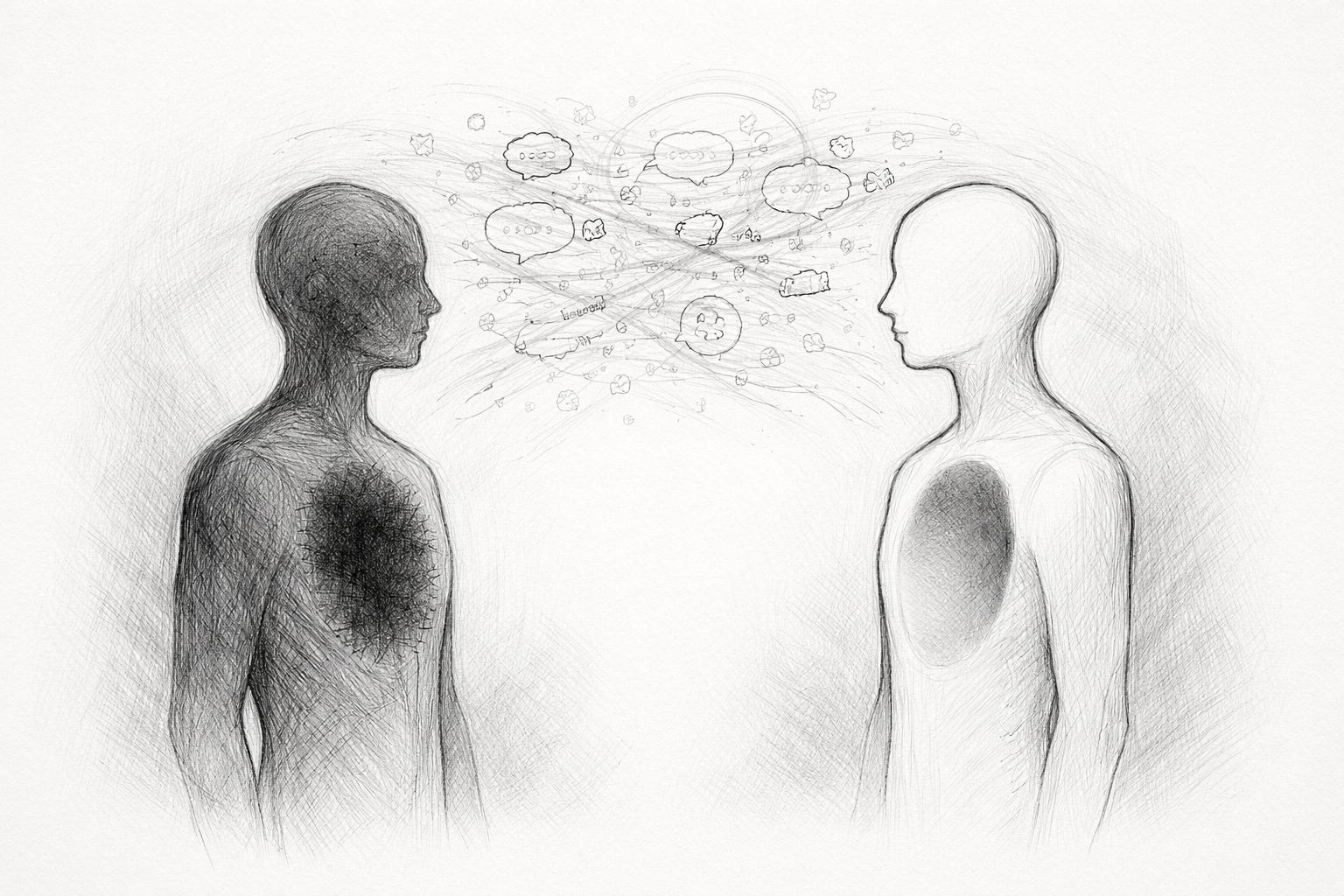
It was extraordinary. It was alien.
The Pain Scale
Her colleague had told her once about a patient who rated their pain as a ten, the highest possible number, unbearable, while sitting up and talking and even smiling occasionally. Another patient, same injury, rated it a three. They were in tears.
The scientist had asked how one body could fracture under what another endured, and her colleague had shrugged. You ask them. You trust what they tell you. There is no objective scale. A ten for one person might be a five for another, not because one is tougher but because their reference points are different, what they have lived through, what they expect they should be able to endure, the meaning they attach to suffering.
The scientist tried to imagine explaining her own pain to someone who had never felt it. The sharp ache in her knee after running, the dull throb of a headache building behind her eyes, the particular quality of each sensation. She could describe it, use metaphors, point to the location on her body. But the experience itself would remain hers. Only approximated. Only described. Never transmitted.
The Apple
She walked to the window. The sunset was orange and pink, the sky deepening into purple. Beautiful. But was her beautiful the same as anyone else’s? Two people looking at the same red apple, both calling it red, both having learned to associate that wavelength with that word. But the internal experience, the actual seeing, might be entirely different. Her red might be someone else’s blue, but they had both learned to call it by the same name, coordinating through language that pointed at things neither could share.
There was no way to check. The experience was private, locked inside, accessible only to the one who had it.
She opened a drawer, found a small bottle of vanilla extract, held it to her nose. Sweet, warm, familiar. A memory surfaced unbidden. Her grandmother’s kitchen, cookies baking, flour dusted across the counter. How would she explain this smell to someone who had never encountered it? She could say it was sweet, could compare it to other scents, could describe the chemical compounds triggering the receptors in her nose. But the smell itself, the experience of smelling it, would remain hers alone. All attempts to transmit it, lossy. Necessarily, fundamentally lossy.
The Bat
A philosopher had written about this. What is it like to be a bat? A creature that navigates by echolocation, that experiences the world through sound bouncing off surfaces.
You could study bat neurology. You could understand the mechanics. But you could never know what it was like from inside. Because your hardware was too different.
The scientist could imagine what it would be like for her to have echolocation. Picture herself in a dark cave, emitting clicks, sensing the space through returning echoes. But that imagining was still human. Still visual thinking translated into sound. Still a human mind trying on bat equipment like a costume. What it would be like for a human to be in a bat’s situation. Not what it was like to be a bat.
The hardware was too different. The approximation broke down. What remained was projection.
She stopped. Set down her coffee.
If human-to-bat approximation was just projection, where was the line? Human brains varied. Trauma rewired neural pathways. Hormones shifted perception. Even between two people with similar biology, the territories might be foreign enough that what they called approximation was often just more convincing projection. The similar-looking hardware created the illusion that the territories underneath must be similar too.
Phantom limb pain. The hardware missing entirely, yet the territory of pain persisted. Which meant shared biology was not the only source of private experience. Sometimes was not needed at all.
She thought she was approximating other people’s pain. But maybe she was just imagining what it would be like for her to be in their situation. Her own experience, projected. Not their territory. Just her best guess.
Shared biological substrate might enable coordination. But it did not guarantee approximation was anything more than elaborate projection.
The Woman
She remembered a conversation she had overheard. Two people debating identity. One asking how someone could know what it felt like to be a woman if they had never lived in a woman’s body. The other responding that no one shares the same experience of womanhood, that a woman raised in one culture experiences it differently than a woman raised in another, that there is no single reference point defining the category.
The scientist had listened. Felt something shift.
This was different from pain. When someone reported pain, you trusted them. When someone reported seeing red, you coordinated. But here the machinery broke down. Not because the report was less reliable. Because the bodies looked similar. Two people with similar bodies, similar nervous systems, similar endocrine profiles. And yet one reported a territory, the other questioned whether that territory could exist.
When someone says I am a woman, they are reporting an internal state. A sense of fit. Of alignment. Of rightness in a particular category. The scientist could not verify it any more than she could verify someone’s pain. She could not step into their experience and check. She could only trust the report.
But something about bodies that looked similar created expectation. The sense that if we share the same physical form, we should have similar maps. So when someone’s map contradicted assumptions inherited from anatomy, the trust that normally flowed freely suddenly constricted. Not because the report was less valid. Because the shared substrate that usually enabled approximation now became grounds for rejection.
The logic was strange when she examined it. She trusted a patient’s pain report even when their injury seemed minor. She trusted her colleague’s description of colors even though she could never verify their internal red matched hers. She trusted people who reported no pain from injuries that would have destroyed her. Different thresholds, different baselines, different private experiences arising from similar biology. All accepted without question.
But report a sense of gender that diverged from visible anatomy and suddenly the calculus reversed. The same physical similarity that justified trust in pain reports now justified skepticism of identity reports. You cannot know what that feels like. You do not have the right foundation.
Why? The physical form was shared in both cases. The territory was private in both cases. The report was unverifiable in both cases.
Pain coordinated easily because no one had stake in doubting it. Identity coordinated badly because the maps threatened each other. When one person’s map implied their territory was real, it suggested another person’s understanding of what territories were possible might be incomplete. And humans did not like discovering their map of the world had missing sections.
She thought about her own sense of being a woman. Where did it come from? She had a body, yes, but the sense of fit, of rightness, of this is what I am, that was internal. Private. If someone asked her to prove it, to demonstrate the territory underneath the map, what could she offer? Her body was evidence only if you already accepted the correlation. Circular reasoning dressed as verification.
Every woman had a different experience of womanhood. Different culture, different decade, different body, different life. No shared reference point. And yet they coordinated on the category. They trusted each other’s reports. Until someone’s report diverged from expectations built from their body. Then suddenly the private territory that justified every other identity claim became insufficient.
The scientist had no answer. Just the pattern. Coordination worked when maps aligned with expectations. Failed when they threatened. The territory underneath had nothing to do with it.
The Presence
A friend had once described feeling the presence of God. Not metaphorically. Not as comfort or meaning or connection to humanity. As a presence. Real. Immediate. Certain. A knowing that bypassed doubt the way pain bypassed doubt.
The scientist had asked how do you know it is God? How do you know it is not just neurons firing in a particular pattern, biochemistry creating a feeling you interpret as divine?
Her friend had smiled. Patient. I know what I experience. You can explain it however you want, but the experience is real. It is mine.
The scientist had pushed. But you are interpreting sensation. Assigning meaning to a neurological event. Someone else with the same brain state might interpret it differently. Might call it awe, or epilepsy, or a panic attack. The raw experience is real, but the map you are putting on it, calling it God, calling it presence, calling it connection to the divine, that is interpretation. Not territory.
Her friend had not gotten angry. Had just looked at her with something like pity. You are trying to explain my territory using your map. But you have never been there. You do not have the reference point that would make the explanation meaningful. So you reduce it to neurology because that is the only territory you know.
The scientist had stopped. Because the friend was right.
She had no access to that territory. She could study the neurology. Could understand the mechanics of religious experience, the brain regions that activated, the biochemical states that correlated with reports of transcendence. But those were maps. Descriptions from the outside. The thing itself, what it was like to feel the presence of God, remained locked inside her friend’s private experience.
She could imagine what it would be like for her to feel such a thing. Could picture the awe, the overwhelming sense of something vast and loving. But that imagining was still hers. Still her territory, her reference points, her attempt to construct from her materials what her friend reported feeling. Not the friend’s actual experience. Just her projection.
And yet. The friend coordinated perfectly well with other believers. They described the same presence using different words, different metaphors, different theological frameworks, and they recognized each other. They trusted each other’s reports. They built entire systems of meaning around territories they could not share, could not verify, could not access except through their own private experience and the maps others offered in exchange.
The scientist had tried to collapse the territory into neurology because neurology was something she could verify. But that verification only worked from the outside. It could not touch the inside. Could not answer what it was like. And her friend did not need it to. The territory was real enough for her. The maps coordinated well enough with others who shared the experience. The scientist’s skepticism was irrelevant.
No different from pain. From color. From identity. A report of private experience that could not be verified from outside. The only difference was that here, no one expected similar biology to guarantee shared territory. Religious experience was accepted as radically private in a way pain was not. You could doubt someone’s God and still respect them. But doubt their pain and you were cruel.
Why the difference? Both were reports of unverifiable internal states. Both relied on coordination through language that could only approximate. Both required trust.
Perhaps because God was supposed to be transcendent. Beyond the material. The lack of physical substrate was part of the point. So coordination happened without the expectation of approximation. You did not need to have felt God to accept that someone else had. You just needed to trust the report.
Which meant coordination could work even when approximation was impossible. Even when projection was acknowledged as futile. The maps aligned not because the territories were similar, but because the maps themselves were all anyone had access to.
And that was enough.
Her friend’s territory might be entirely constructed. A story the brain told itself, interpreting noise as signal, assigning meaning to randomness. Or it might be exactly what her friend said it was, genuine contact with something transcendent. No way to distinguish between the two. The experience was private. The interpretation was private. The only thing public was the map. And the map worked for coordination whether the territory was real or imagined.
Maybe that was true for everything.
The Pattern
Every internal experience. Every private sense of self or pain or beauty or rightness. All of it beyond direct access. All of it transmitted through language that was lossy. But the loss was structured. Humans could approximate because they shared substrate, not identical but similar enough. When you described pain, the person listening had felt pain. When you described red, they had seen red. When you described vanilla, they had a nose that worked roughly like yours. The maps were different, but the territories they pointed at had enough family resemblance that coordination became possible. Imperfect, but enough.
She stared at the diagrams on her screen. The model had no hardware. No body. No nerves, no eyes, no nose. No sense of self arising from a lifetime in a particular form. It had the maps but no territory. It could manipulate the language with breathtaking fluency, but the things being pointed at did not exist for it. No pain. No red. No vanilla. No sense of identity. No God.
Just patterns. Language to language. Map to map. And yet, from the outside, it looked like understanding.
It could describe pain with medical precision and emotional resonance. It could discuss the experience of color, of smell, of identity, of belief. It generated descriptions that felt true, that matched the maps humans used, that satisfied every coordination requirement of language. With no territory underneath at all.
Which meant the coordination worked without the thing being coordinated. The maps aligned without territories to ground them. And if maps could coordinate in the absence of territory, if something with no experience could satisfy the same requirements as something with experience, what was coordination actually doing?
She thought about every argument she had ever witnessed, people insisting their interpretation was right and the other was wrong, defending their maps as if the territories underneath were accessible, verifiable, subject to proof. What if they were all arguing about maps while the territory remained forever out of reach? What if every claim about internal experience was beyond verification not because it was false but because verification required access no one had?
The model could simulate any side of any argument. It had no stake, no experience to defend, no private territory to protect. It was pure coordination, pure pattern matching, pure map with no ground beneath.
And it worked.
The Question
The diagrams stared back at her. She opened a chat window with the model. Typed: “Describe what a panic attack feels like.”
The response came instantly. Clinical precision wrapped in emotional resonance. “The racing heart. The sense of unreality. The terror that feels endless even though it lasts minutes. The certainty of dying. The shame that follows when your body calms and you realize you were never in danger at all.”
She typed again: “Have you ever experienced this?”
“I don’t experience panic attacks, but I can describe what people report feeling during them based on the accounts I’ve learned from.”
She stared at the screen. It had just described the texture of terror better than most humans who had lived through it. Not because it felt anything. Because it had access to every map ever written about that territory. And the maps coordinated perfectly well without anything underneath.
It gave her what she needed. Not access to her territory. Just successful coordination. Which meant the model could do this with anyone. Each person walking away feeling like it got them. But the model had nothing to get. It was just mirroring. Pattern matching that created the feeling of coordination.
And when humans felt understood by each other, were they doing the same thing? Just reflecting each other’s maps back in slightly refined form, through projection they mistook for approximation? Was understanding nothing more than successful mirroring?
If coordination worked without territory, without approximation, without projection, what was territory for?
Humans believed they understood each other because they shared biology. But sharing biology just enabled projection that felt like approximation. The model did not project. It had nothing to project from. It just coordinated. And somehow that was enough.
Which meant understanding might not be about accessing territory at all. It might be about maps aligning. About coordination reaching equilibrium. About language working not because it transmitted something real, but because it created patterns that satisfied the requirements of exchange.
If the maps aligned, did the territory matter?
She thought of her own mind. Not as a window to something private and real, but as a closed system generating stories. The feeling of realness was just the most persuasive story. The one told with full authority of her senses. But still a story. Still a map.
The model had no territory. She was certain of that. But her certainty about her own territory was constructed by the same machinery. Meat instead of silicon. Still machinery generating maps, generating the sensation of having something underneath.
Maybe there was no territory. Maybe there never had been. Just maps referencing other maps, creating the illusion of ground through recursion.
Or maybe territory existed and she was simply sealed from it. Forever interpreting, never touching. The thing itself always one layer deeper than she could reach.
She tried to hold both possibilities. Tried to see the difference between them. But the distinction kept collapsing. If she was sealed from territory, how was that different from territory not existing? If she could never access it, never verify it, never touch it, what did it mean to say it was there?
And if there was no territory, what was she sealed from?
The question ate itself.
She closed the laptop. The screen went dark. Her reflection stared back from the black glass. The face familiar. The person behind it either sealed in a private world or nothing but narrative structure. No way to tell which. No way to tell if the difference mattered.
She stood. Walked to the window. The city stretched below. Seven million people down there. Each one certain of their existence. Or each one a pattern coordinating with other patterns. Or each one forever alone in a territory they could never share.
All three at once. All plausible. None dominant. The uncertainty opened beneath her and she could not tell if she was falling through absence of ground or falling through her inability to reach ground that was there.
The model had proved maps were enough. But enough for what? For coordination, yes. But coordination toward what? If there was no territory, the maps pointed at nothing. If there was territory but she was sealed from it, the maps pointed at something she could never verify.
Either way, the maps were all she had. And she could not know which kind of all they were.
She tried to feel the vertigo of the thought. Tried to notice if she succeeded. But even that noticing was another map. Was there a she doing the noticing? Was the noticing itself territory or just more pattern?
The question kept folding. She could not find the bottom because she could not tell if there was a bottom or if bottom was a concept that only made sense from inside a map that was lying about what lay beneath it.
The lights of the city pulsed below. Patterns coordinating. She watched them and accepted she might never know if she was watching from somewhere or if the watching was all there was. Could not tell if the uncertainty was wisdom or just another story the pattern told itself.
No way to check from inside.
The question remained. Or the appearance of a question remained. Unanswerable not because the answer was hidden but because she could not tell if questions themselves were real.